Affichage des articles dont le libellé est en. Afficher tous les articles

vendredi 5 novembre 2010

:: Space, stars ans slimy aliens.


Check this book out, space stars and slimy aliens. It is from the horrible sciences series.
Funny amusing book where you travel through the solar system with aliens and discover stars.
Most of it is true except for the slimy aliens.
Don't be to scared with the horrible stuff...
It's for children but of course if the adult wants to read it with the child...
lundi 11 octobre 2010

:: Phobos


Phobos is one of the two satellites (moons) of Mars, Deimos his neighbor is a bit smaller.
As you probably know the asteroid belt is between Mars and Jupiter and we think that Phobos was an asteroid from this belt captured by the gravity of Mars and has become one of its moons.
It has a very small size and is not a sphere which is another reason for us to assume that it was an asteroid.
Diameter:10km
Discovered by: Asaph Hall
Discovery date: August 18, 1877

lundi 1 mars 2010

:: Pluto

Pluto is a planet after Neptune. We are still discussing if it's a planet or a dwarf planet, my opinion is it's a dwarf planet, I wonder what you think.

I think it's a dwarf planet because it's smaller. It is too far away from the sun. Pluto has 3 moons its largest one is called Charon which is about half the size of Pluto.
Charon is unusual in that it is the largest moon with respect to its primary planet in the Solar System. Some prefer to think of Pluto/Charon as a double planet rather than a planet and a Moon.

The temperature on Pluto's surface is between -210 and -240.
Pluto was discovered in1930 by astronomers.
Pluto is smaller than 7 moons in the solar system.
If you weigh 70 pounds on Earth you'll weigh 4 pounds on Pluto; that's because Pluto's much smaller, which means it has a smaller core; the core creates gravity so the smaller the core, the smaller the gravity.

For 20 years, Pluto was closer to the sun than Neptune. It will be about 240 years before they swap again.


lundi 23 novembre 2009

:: Io la lune de Jupiter

Français


Io est la troisième plus grande lune de Jupiter ;
Elle est aussi grande que notre lune.
Il a beaucoup de différentes couleurs
parce que c'est le corps céleste qui a le plus de volcans.
Les montagnes de Io sont beaucoup plus grandes
que les montagnes terrestres.
Elle a été découverte en 1610 par Galilée et Marius.

English
Io is as big as our moon.
Io is the third largest moon from Jupiter and the.
It is really coulourful because it is the most volcanic body known.
Io's mountains are much bigger than ours.
It was dis covered in 1610 by Galilei and Marius.

vendredi 11 septembre 2009

:: Hubble : ses dernières superbes photos de l'univers

I saw incredible photos (from the Hubble space telescope)... If you want to see them, clic here ou here.
Pour voir les dernières photos, très belles, du télescope Hubble, cliquez ici ou .

jeudi 25 juin 2009

:: Une nouvelle mision pour la lune / A new mission to the Moon

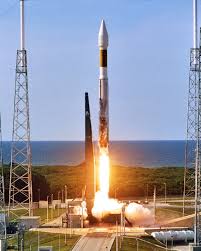
Atlas 5 est une fusée partie pour la lune. C'est la première mission pour la lune depuis 10 ans. Il s'agit de trouver de la glace d'eau et de rapporter de belles images. Elle transporte deux sondes.

Atlas 5 is a rocket to the moon. It is the first mission in 10 years to go to the Moon. It is looking for water ice and going to take pictures of the Moon. It is carrying two space probes.

:: Une photo de Mercure / A photo of Mercury

If you want to see the photo, clic here.
Si vous voulez voir une photo de Mercure, cliquez ici.

jeudi 18 juin 2009

:: Photos of the solar system / Photos du système solaire


Voici plusieurs photos du système solaire et de toutes les planètes du système solaire, avec Pluton (qui est une planète naine).


Here are some photos of the solar system and its planets, plus Pluto (which is a dwarf planet).

:: Exo planet with a strange orbit.

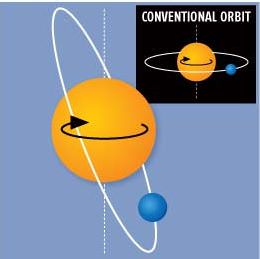
Astronomers have found a planet with an odd orbit.
The planet is 10 times as big as Jupiter!

lundi 15 juin 2009

:: Rockets

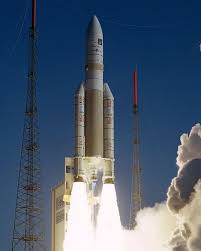
Rockets are objects that can make us travel in space!

There is a rocket that is in orbit around the Earth; it is called a space station. Rockets need: a motor, some plants, a window, communication material to communicate with Earth, special toilets, special food, special showers, scientific equipment and other things!!!!

In a rocket there is no gravity: that is the reason why astronauts float all the time.

Rockets are a lot faster than airplains and they go much further away.

A long time ago, rockets were invented in China.

mercredi 10 juin 2009

:: Exoplanets

Exoplanets are planets that are not in the solar system.
We have found lots of exoplanets : for example, one is 2 times as big as the Earth.

:: Mars [video]

I found a video who explains a lot about Mars...

mardi 9 juin 2009

:: Moon, comets and shooting stars...

Moon:
Long before the dinosaurs, there was no moon! One day a comet crashed into the Earth, It set the whole earth on fire!!! Rocks went into orbit around the Earth. In a very short time all the rocks came together and it formed the moon.

Comets and shooting stars:
At first, comets are ice and rocks. Then comets pass next to a star. The star is so hot that the ice of the comets melts and the rocks start burning. Then the comet goes into the Universe. Sometimes it comes near the Earth so we can see them and then we call them shooting stars.

lundi 8 juin 2009

:: 4 moons of jupiter [vidéo]

:: Voyager 1 and voyager 2

Voyager 1 and 2 are spacecrafts.

Voyager 1 :
Voyager 1 started observing Jupiter in January 1979: it discovered Jupiter's moons and also
took super photos.
Then it went to visit Saturn. It went past all the planets and then went out of the solar system.
Voyager 2 which had stayed with Voyager 1, left it and carried on its journey.


Voyager 2:
Voyeger 2 staid with its twin and when it had gone through the solar system, it left voyager 1 and took an other way. No, it is taking super photos and discovering lots of things (like its twin brother which is in the opposite direction).

samedi 6 juin 2009

:: Mercury

Mercury is the smallest planet if you do not count dwarf planets, and the closest to the sun.
It is a bit larger than our moon but a bit smaller than the earth. We started to oserve Mercury in 1960.
Mercury has no moons.
For the Romans, Mercury was Messager of the Gods.
  • Diameter: 4 900 kms.
  • Distance to the sun: 58 million kms.
  • Duration of rotation: 59 days.
  • Duration of revolution: 88 days.

jeudi 28 mai 2009

:: Atlantis est revenue / came back !

Les astronautes partis réparer le télescope Hubble sont revenus. Leur navette Atlantis avait un parachute pour ralentir...

The astonauts who went for the reparation of Hubble came back. They needed a parachute to slow down at the end...


Reblog this post [with Zemanta]

:: Stars

Stars
Some of them are big bl
ue ones, big red ones, yellow ones and red ones. Big blue ones are the hottest ones.
Red ones are stars at the end of their lives a
nd they are the coldest ones.
Yello
w stars are like our Sun (which is a yellow star!).
R
ed ones are the best known ones.
I
n countries that do not have too much polution we can sometimes see more than 3000 stars all over the sky.
The big ones are 100 to 200 times larger than the Sun. Stars
are composed of gaz and fire.
Reblog this post [with Zemanta]

vendredi 22 mai 2009

:: Mars 2 moons: deimos and Phobos

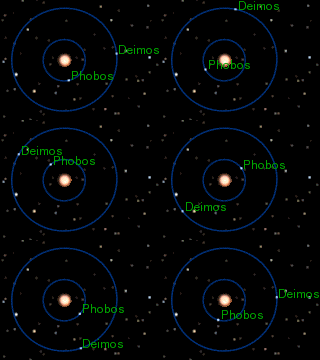
Mars has two moons : Phobos and Deimos.

Phobos:
Diameter: 10 kms
Distance to Mars: 9000 kms
It is composed of different kinds of rocks.
It looks like an asteroid.


Deimos:
Dimensions (it is not round): 10 x 12 x 15 kms.

jeudi 21 mai 2009

:: Mars

It is located just after the Earth and it is the seventh largest planet.
It is red because its desertic surface made of rocks, has a reddish colour, due to the clouds of iron dioxide raised by strong winds.
For the Romans, Mars was the God of war.
Mars is visible at night without a telescope.
The first satellite to visit Mars was Mariner 4; it was followed by others.

The largest volcano in the solar system is situated on Mars, it is called Olympus Mons. The Diameter of Olympus is 648 km and its height is 22.5 kilometers.

Scientists are still trying to discover if there was life on Mars a long time ago, a proof that there could be is that astronomers are sure that there has been water on mars. NASA's Phoenix mars lander discovered water ice on mars the fourth august 2007.

  • Distance to the sun: 228 million kms.
  • Diameter: 6794 kms.
  • Duration of revolution: 687 days.
  • Duration of rotation: 1 days and 37 minutes.
  • Temperature: -133 °c to 27°c!!!